 |
| Bocas Del Toro - Panama |
Tuesday, December 27, 2011


Monday, December 12, 2011
Costa Rica to Panama and a hummingbird with no passport
Just arrived in Bocas Del Torro, Panama. After the Yoga retreat was over, I moved to a small place across the street from the Caribbean waters where people were surfing. Had extra rain, after not having almost any for a week. It was nice rainforest rain, warm and relaxing. As I write here on the balcony of Hotel Olas, facing the water, a hummingbird keeps flying back and forth, showing off her little dance and long beak. Does she care she lives in Bocas?
The shuttle to Panama began with a minivan ride, chatting in Spanish with the driver and sharing torta y bananas, then crossed the border, walking over a very old rusty bridge, with lots of gaps between the boards (it used to be a railroad bridge), passport control through a mostly dark window of a run down, peeling blue wooden hut, while I am standing under grey sky, taking a pause from crying over the earth. (Of course I gave Lauren my rain Jacket, thinking I can always be OK without it - and I am. The rain poured mostly when in the car. When I needed to cross the bridge it stopped, waited till I finished all passport control stuff, and only resumed while I got back into the car - good rain Karma!!).
I step into a small room, to get a stamp in my passport, literally a little paper stamp in exchange for 3 dollars. Next desk is something like costumes. The man checks my knapsack and then points to a small door beside him. As I step in, I realize it’s a small toilet. Hmmm, what next? He points to my belly. Oh, Of course he wants me to lift the shirt to see I have no weapon, right? Well, no. Cash, he says. Cash?? Where is your money? In my bag, I respond. Show me, he demands in Spanish. I go to my bag, get the Ziploc, place it in my pocket and walk back to the tiny toilet. I hand him the cash. Earlier I had to declare how much money I am bringing in, so I thought, maybe he will check if the sum is right. I declared $1500, but really had only $700. He pulls out the money and goes through it, holding one bill after the other against the light shining from the tiny window above. He is not counting it, but rather making sure it is real. There is lots of fake money being passed into Panama, and they are controlling the money. OK. Done. I take my stuff, head to the next mini van for another hour or so ride. We arrive at the water; get into a speedboat, and head over to Bocas del Toro. Calm waters, passing islands of floating green vegetation. My butt hurts from the wooden seat; so I drop my thinking mind, soften my gaze towards the water, and surrender. Suddenly I am gone; water, sky and islands are here.
Lots of sail boats around. I take my carry on and walk off the boat, while everyone else has a backpack. I decide not to worry about what other people are thinking of me right now. I walk towards a hotel that maybe has my reservation. I was emailing them, but at a certain point they stopped emailing back. (Was it my lack of ability to send Western Union from Porto Viejo?) As I walk down the chill out street of Colon, the main island, wondering whether I have where to stay tonight, a few hustlers tried to offer me other places, but I think I look seasoned enough, that they did not bother me at all.
I got my room, pretty much exactly what I was hoping for. Well, a bit better really. Though I am in a standard room, from my bed I can see the ocean. The whole house is on stilts floating on the water. So with a slight angle I get the entire ocean. There is a public balcony with panoramic views (photos soon), and some chill out couches, perfect for me doing work. Oh, humming bird is back. She seems content to wander around freely, with no passport or cash, finding her food one moment at a time.
When registering I was offered coffee and cake. The man bringing it over spoke Spanish, but had a thick accent when speaking English. Not really a Spanish accent. It turns out his name is Avi, and you can guess where he is from! 20 years in Colombia, and now this is another business of his.
I asked the receptionist for another room that seemed open, and she said it was booked. Later, when I came down, I heard Avi asking her to switch me to that room. You never know when it pays off being Israeli.
The shuttle to Panama began with a minivan ride, chatting in Spanish with the driver and sharing torta y bananas, then crossed the border, walking over a very old rusty bridge, with lots of gaps between the boards (it used to be a railroad bridge), passport control through a mostly dark window of a run down, peeling blue wooden hut, while I am standing under grey sky, taking a pause from crying over the earth. (Of course I gave Lauren my rain Jacket, thinking I can always be OK without it - and I am. The rain poured mostly when in the car. When I needed to cross the bridge it stopped, waited till I finished all passport control stuff, and only resumed while I got back into the car - good rain Karma!!).
I step into a small room, to get a stamp in my passport, literally a little paper stamp in exchange for 3 dollars. Next desk is something like costumes. The man checks my knapsack and then points to a small door beside him. As I step in, I realize it’s a small toilet. Hmmm, what next? He points to my belly. Oh, Of course he wants me to lift the shirt to see I have no weapon, right? Well, no. Cash, he says. Cash?? Where is your money? In my bag, I respond. Show me, he demands in Spanish. I go to my bag, get the Ziploc, place it in my pocket and walk back to the tiny toilet. I hand him the cash. Earlier I had to declare how much money I am bringing in, so I thought, maybe he will check if the sum is right. I declared $1500, but really had only $700. He pulls out the money and goes through it, holding one bill after the other against the light shining from the tiny window above. He is not counting it, but rather making sure it is real. There is lots of fake money being passed into Panama, and they are controlling the money. OK. Done. I take my stuff, head to the next mini van for another hour or so ride. We arrive at the water; get into a speedboat, and head over to Bocas del Toro. Calm waters, passing islands of floating green vegetation. My butt hurts from the wooden seat; so I drop my thinking mind, soften my gaze towards the water, and surrender. Suddenly I am gone; water, sky and islands are here.
Lots of sail boats around. I take my carry on and walk off the boat, while everyone else has a backpack. I decide not to worry about what other people are thinking of me right now. I walk towards a hotel that maybe has my reservation. I was emailing them, but at a certain point they stopped emailing back. (Was it my lack of ability to send Western Union from Porto Viejo?) As I walk down the chill out street of Colon, the main island, wondering whether I have where to stay tonight, a few hustlers tried to offer me other places, but I think I look seasoned enough, that they did not bother me at all.
I got my room, pretty much exactly what I was hoping for. Well, a bit better really. Though I am in a standard room, from my bed I can see the ocean. The whole house is on stilts floating on the water. So with a slight angle I get the entire ocean. There is a public balcony with panoramic views (photos soon), and some chill out couches, perfect for me doing work. Oh, humming bird is back. She seems content to wander around freely, with no passport or cash, finding her food one moment at a time.
When registering I was offered coffee and cake. The man bringing it over spoke Spanish, but had a thick accent when speaking English. Not really a Spanish accent. It turns out his name is Avi, and you can guess where he is from! 20 years in Colombia, and now this is another business of his.
I asked the receptionist for another room that seemed open, and she said it was booked. Later, when I came down, I heard Avi asking her to switch me to that room. You never know when it pays off being Israeli.
Costa Rica, Samasati yoga retreat
The group left. I stood by the 4x4 Japanese metallic green car, waiving at the people inside. They are on their way to the airport, passing through the Costa Rica rain forest, heading back to the US. A week of Yoga and meditation with dharma talks focusing on understanding the tendencies of our minds and how to clear it.
Though the group was pretty diverse, there was beautiful group energy, a support system created organically, and even some deep friendships or as one student said “I found my sister”.
Reggae blends with Latin, blacks with Hispanics, expats with serious tans, blond moms with Costa Rican looking kids, a blend of cultures, music and food, mixed with the ocean spice, topped off with jungle life. Sounds like it could be a mess, but rather it is one of the most peaceful, accepting and non-racist places I have ever encountered.
Wandering around the main strip of Porto Viejo is a delight, with plenty of little shops, bars and restaurants. With the ocean just a few steps away, maybe having a drink, possibly the local Imperial beer, (I chose the regular which is more of an amber color), or eating a Casado, the local classic of rice, beans, non veggie protein and fried plantains, on one big white plate, served hot and assured to satisfy a hungry stomach.
Down the road from Porto Viejo, we rode our red cruise bikes along small retreats, hostels, a bakery, an animal rescue, crossing a few rivers, all surrounded by the rain forest life. A huge neon blue butterfly flirts with me as I ride my bike, sloths watch us lazily from above, signs announcing land for sale, and in general a pretty mellow vibe.
Riding along the river we arrive at Playa Punta Uva, a beach spotted with palm trees bearing heavy coconuts, some cliffs with rain forest growth on one of its curves, medium waves washing away the footprints on the sand, allowing us to feel over and over again the rebirthing of a new moment.
Morning sessions of yoga which included workshop like tips and practices were followed by a delightful ocean view breakfast buffet. Then, a day at the beach, horseback riding, kayaking or a canopy tour, sometimes known as zip lining. A harness strapped around our hips, a cable stretching over the rain forest for as long as the eye can see, zipping over a valley that seems so far below. Legs up and off I go. I lean back as I choose to go as fast as possible, enjoying the surrender of effortless movement merging into nature, before landing at the platform revealed between the enormous leaves that seem to be on steroids. Really, all of nature is much greater here. From spiders, to butterflies, from leaves to trees, all seem to flourish on Mother Nature’s abundance. We hike from one platform to another, finding ourselves high up on hanging platforms deep within the rainforest. After 20 or so platforms we arrive safely back to enjoy deliciously sweet pineapples and bananas.
Early morning symphony of bird singing is as grand as any orchestra, with a deep drumming base of the howling monkeys, which at times sounds like roaring lions.
The sounds in Costa Rica are just as much of an experience as the sights. Especially up at Samasati, which was specifically architected to give the true nature feel of the rain forest. I saw monkeys, amazing butterflies, hummingbirds, and even toucans there. The simple and beautiful constructions of our bungalows from local wood, the morning juices from the fruit grown on the property, and the coffee, that even those with the most hedonistic taste would commend. Add to that the warmth of the local people working there, the views, and the good vibes, and you know this is as close to bliss as it gets.
We added our own tunes, with a night of Zen Dance as well as a night of Osho Kundalini Meditation. Finding freedom within our bodies, our minds, and dropping into the presence of love and group support, it was like watching flowers open up revealing their true color, every day shining with more radiance.
I sit here on my supportive hammock on my bungalow deck sipping in peace and content as the group heads back. I wish you all to follow your intentions, to take on your new clarities and practice them, so they keep shining through, and to share the gift of this experience with those that could not be with us.
With deep gratitude to Lauren my wife for her unparalleled support, to the amazing group that held the space for each other and was willing to open up, to Samasati for their hospitality, to the people and the land of Costa Rica for sharing the abundance and love with us.
We will be back!
Though the group was pretty diverse, there was beautiful group energy, a support system created organically, and even some deep friendships or as one student said “I found my sister”.
Reggae blends with Latin, blacks with Hispanics, expats with serious tans, blond moms with Costa Rican looking kids, a blend of cultures, music and food, mixed with the ocean spice, topped off with jungle life. Sounds like it could be a mess, but rather it is one of the most peaceful, accepting and non-racist places I have ever encountered.
Wandering around the main strip of Porto Viejo is a delight, with plenty of little shops, bars and restaurants. With the ocean just a few steps away, maybe having a drink, possibly the local Imperial beer, (I chose the regular which is more of an amber color), or eating a Casado, the local classic of rice, beans, non veggie protein and fried plantains, on one big white plate, served hot and assured to satisfy a hungry stomach.
Down the road from Porto Viejo, we rode our red cruise bikes along small retreats, hostels, a bakery, an animal rescue, crossing a few rivers, all surrounded by the rain forest life. A huge neon blue butterfly flirts with me as I ride my bike, sloths watch us lazily from above, signs announcing land for sale, and in general a pretty mellow vibe.
Riding along the river we arrive at Playa Punta Uva, a beach spotted with palm trees bearing heavy coconuts, some cliffs with rain forest growth on one of its curves, medium waves washing away the footprints on the sand, allowing us to feel over and over again the rebirthing of a new moment.
Morning sessions of yoga which included workshop like tips and practices were followed by a delightful ocean view breakfast buffet. Then, a day at the beach, horseback riding, kayaking or a canopy tour, sometimes known as zip lining. A harness strapped around our hips, a cable stretching over the rain forest for as long as the eye can see, zipping over a valley that seems so far below. Legs up and off I go. I lean back as I choose to go as fast as possible, enjoying the surrender of effortless movement merging into nature, before landing at the platform revealed between the enormous leaves that seem to be on steroids. Really, all of nature is much greater here. From spiders, to butterflies, from leaves to trees, all seem to flourish on Mother Nature’s abundance. We hike from one platform to another, finding ourselves high up on hanging platforms deep within the rainforest. After 20 or so platforms we arrive safely back to enjoy deliciously sweet pineapples and bananas.
Early morning symphony of bird singing is as grand as any orchestra, with a deep drumming base of the howling monkeys, which at times sounds like roaring lions.
The sounds in Costa Rica are just as much of an experience as the sights. Especially up at Samasati, which was specifically architected to give the true nature feel of the rain forest. I saw monkeys, amazing butterflies, hummingbirds, and even toucans there. The simple and beautiful constructions of our bungalows from local wood, the morning juices from the fruit grown on the property, and the coffee, that even those with the most hedonistic taste would commend. Add to that the warmth of the local people working there, the views, and the good vibes, and you know this is as close to bliss as it gets.
We added our own tunes, with a night of Zen Dance as well as a night of Osho Kundalini Meditation. Finding freedom within our bodies, our minds, and dropping into the presence of love and group support, it was like watching flowers open up revealing their true color, every day shining with more radiance.
I sit here on my supportive hammock on my bungalow deck sipping in peace and content as the group heads back. I wish you all to follow your intentions, to take on your new clarities and practice them, so they keep shining through, and to share the gift of this experience with those that could not be with us.
With deep gratitude to Lauren my wife for her unparalleled support, to the amazing group that held the space for each other and was willing to open up, to Samasati for their hospitality, to the people and the land of Costa Rica for sharing the abundance and love with us.
We will be back!
Wednesday, October 12, 2011

Tuesday, May 3, 2011
Worth Remembering
”It is worth remembering, that it is much more disheartening to have to steal than to be stolen from” Boris Lermontov [to Julian Craster] in the movie: The Red Shoes, 1948.
When someone takes from us, it means we had something. We had something that could be taken away. You can practice anger and loss, or celebrate that you had it to begin with, did not need to take it from others, and even practice compassion towards the thief that needed it so badly, that they had to go and steel it.
You may lose and idea, a concept, money, jewelry or even a relationship. Celebrate it while you have it, and allow it to continue its flow in the universe, as it was never really yours to begin with.
May you know lots of generosity in your life!
Blissful Living,
Doron
PS. Ready to find more balance in your life? Join me at Esalen, May 27-29.
Sign up now with 2 friends, and you all receive 10% off!
http://doronhanoch.com/Retreats/esalen.html
When someone takes from us, it means we had something. We had something that could be taken away. You can practice anger and loss, or celebrate that you had it to begin with, did not need to take it from others, and even practice compassion towards the thief that needed it so badly, that they had to go and steel it.
You may lose and idea, a concept, money, jewelry or even a relationship. Celebrate it while you have it, and allow it to continue its flow in the universe, as it was never really yours to begin with.
May you know lots of generosity in your life!
Blissful Living,
Doron
PS. Ready to find more balance in your life? Join me at Esalen, May 27-29.
Sign up now with 2 friends, and you all receive 10% off!
http://doronhanoch.com/Retreats/esalen.html
Thursday, March 31, 2011
Are you real?

This is a photo of my nieces Maya and Kayla. They are truly wonderful. Their genuine smiles and laughter,their joy for the little things in life, their appreciation of food... And they never pretend to like me, even when their mommy asks them to. They come to me when they want and laugh with me when they want to, they are themselves, and that is beautiful. They dress up and pretend when THEY want to, and not to be nice, but to celebrate life. Are you REAL?
Tuesday, January 18, 2011
Holy Cow! Happy Sankaranti!
Happy Sankaranti!(Shankranti)
All the cows seemed to have vanished, the streets are quiet, few people around, its the Harvest Holiday, a new year. Much of the festivities take place in the fields or other wise in the homes, drinking Badam Milk (almond and cow milk) and eating Pongal a specialty dish for the holiday made of mushy grains and beans (Kitchari like) in two variations, sweet and spicy.
Efrat volunteers to take me to the cow area. Its not far from where I live, we walk passed the Mandala house where I study, cross double road, named thus since it has a big, black and yellow metal fence dividing it into two equals, and down the street I can already see a cow tied to the fence of a large park. Mysore has parks galore, some small and some large, most with walking paths and benches, coconut trees, lots of plants and a fence to guard it so that no one but humans can go in, part of Mysore’s charm.
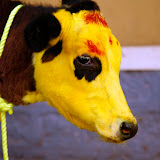
We walk towards the cow that is painted yellow in all the spots that are not dark. To our left appears another street with three sheep, a young cow and a calf, all colored yellow. My lips stretch to my ears, a bit surreal, but then again India always is a bit like a movie set, with its own orderly chaos and plenty of dotted beauties, like Bindis on a young girls forehead.
After a while using my camera, I decided that today is a good day to stretch its buttons and twist its focus ring. It was a great feeling of liberty to just walk around without the need to capture, to hold on to the visuals in a permanent form (temporary permanence really), seeing at the present moment with nothing as a barrier between reality and me. Today is a holiday, and as part of the celebration all the cows are painted yellow, turmeric is the color, so it is all natural, healthy, anti-inflammatory and strength giving. It is a great day to share my love to this beautiful animal, in its beautified form of yellow and red painted horns, sometimes with sparkles, sometimes with an Ohm painted on its rear. The camera, when used as part of the celebration, as a means of communication rather that greed, can be an enhancer of reality. It was like that on my trip to Cuba where I only had a 24mm wide angel lens, forcing me to really make contact with the people, to be part of the photo without being in it, a project I started back when I took photos of my parents, creating a triangle of emotion with out me being visually in the frame. I now have a 24-105 zoom, but this still does not allow me to hide and reach far with my zoom to capture an unaware soul, I still am in the midst of life, and with digital even more so. The kids ran up to me and asked me to take photos of them with their cow, or of their little sister, or aunt eating in the window, and then they would want to look at my little screen, to see themselves appear like magic on my magic screen. Their eyes bright with joy, open hearted and wanting to share, their moms inviting us in to eat, “please, you come inside”, when I refused gently, they would run out with a little bag of sweets, like trick or treat, sharing their blessings. Stepping over cow poop, passing by dried cow dong drying on the wall as it will be used for fire later, another cow, being painted goats horns on its forehead with red and gold glitter, little girls dressed in their fanciest cloths, with beautiful dresses of bright colors, sequence and shiny materials offering translucent material covering their arms, lots of colorful shiny bangles singing along with their anklets as they walk. Kids dragged us from one street to the next, “come see my cow”, “this is my house, please come in”, “my uncle”, or any other declarations, wanting to share, feeling pride of connecting with us fortunate foreigners.
In the evening after walking around the lake and seeing the sunset, with the left shin hurting form all the walking, feeling tired, yet hydrated with fresh coconut water, Lauren, Efrat and myself, returned to the cow area, as at night they take the cows to jump over fire. Some of the afternoon kids find us and lead us around. We end up going into one of the homes, drinking some fresh Badam milk, and I mean fresh. The first floor hosts the cows and some sheep, we enter the door, skip the urine, leave our sandals below on the nice tiled steps but not too close to the sheep that want to chew on it, and go up stairs. Downstairs the lighting was tungsten yellow, pale, contrasted with the living room that shone with bright greenish neon lights turning neutral with the light yellow paint on the wall, mostly bare, as was the room apart from a TV and a few plastic chairs. Some huge metal pots containing fresh milk stood in the hallway, one of them being heated (to drink or to clean bacteria?). We are offered seats and some food. We get plates with yummy Pongal. Some hesitation as of for the raw milk from my friends, but I dive right into it, loving the idea of fresh raw milk, a slight after taste of grass.
Load music came from outside, ”dancing, dancing, please you come”, offered the young man that until now was just standing and watching us eat, as if it were a rare view (and maybe it was). We took to the balcony watching the young kids dancing in the street. Cows near by, cow poop on the side, a bright light illuminating so the one video camera in the neighborhood could document the beautiful kids with their marvelous outfits dancing some Bollywood moves. Before long we are down on the street shaking and moving as well, the girls really, I was still finishing my Badam milk, and holding my bit too large of a camera.
We continued along to see some fire hopping. It turns to be some burning hay on the street with a man dragging the cows though it. There sure was fire, yellow cows and even a man going through it, though maybe not so much of any big hopping. The cows went back and forth a few times, there was something really amazing about this, though the cows as holy as they are were not very respected of their own wills.
The cows are holy as long as they provide he precious milk. They are mostly not eaten, though secretly some, like my landlord will admit “it gives great strength to eat a cow, as long as you do not eat pigs, witch will turn you into an evil man.”
All the cows seemed to have vanished, the streets are quiet, few people around, its the Harvest Holiday, a new year. Much of the festivities take place in the fields or other wise in the homes, drinking Badam Milk (almond and cow milk) and eating Pongal a specialty dish for the holiday made of mushy grains and beans (Kitchari like) in two variations, sweet and spicy.
Efrat volunteers to take me to the cow area. Its not far from where I live, we walk passed the Mandala house where I study, cross double road, named thus since it has a big, black and yellow metal fence dividing it into two equals, and down the street I can already see a cow tied to the fence of a large park. Mysore has parks galore, some small and some large, most with walking paths and benches, coconut trees, lots of plants and a fence to guard it so that no one but humans can go in, part of Mysore’s charm.
We walk towards the cow that is painted yellow in all the spots that are not dark. To our left appears another street with three sheep, a young cow and a calf, all colored yellow. My lips stretch to my ears, a bit surreal, but then again India always is a bit like a movie set, with its own orderly chaos and plenty of dotted beauties, like Bindis on a young girls forehead.
After a while using my camera, I decided that today is a good day to stretch its buttons and twist its focus ring. It was a great feeling of liberty to just walk around without the need to capture, to hold on to the visuals in a permanent form (temporary permanence really), seeing at the present moment with nothing as a barrier between reality and me. Today is a holiday, and as part of the celebration all the cows are painted yellow, turmeric is the color, so it is all natural, healthy, anti-inflammatory and strength giving. It is a great day to share my love to this beautiful animal, in its beautified form of yellow and red painted horns, sometimes with sparkles, sometimes with an Ohm painted on its rear. The camera, when used as part of the celebration, as a means of communication rather that greed, can be an enhancer of reality. It was like that on my trip to Cuba where I only had a 24mm wide angel lens, forcing me to really make contact with the people, to be part of the photo without being in it, a project I started back when I took photos of my parents, creating a triangle of emotion with out me being visually in the frame. I now have a 24-105 zoom, but this still does not allow me to hide and reach far with my zoom to capture an unaware soul, I still am in the midst of life, and with digital even more so. The kids ran up to me and asked me to take photos of them with their cow, or of their little sister, or aunt eating in the window, and then they would want to look at my little screen, to see themselves appear like magic on my magic screen. Their eyes bright with joy, open hearted and wanting to share, their moms inviting us in to eat, “please, you come inside”, when I refused gently, they would run out with a little bag of sweets, like trick or treat, sharing their blessings. Stepping over cow poop, passing by dried cow dong drying on the wall as it will be used for fire later, another cow, being painted goats horns on its forehead with red and gold glitter, little girls dressed in their fanciest cloths, with beautiful dresses of bright colors, sequence and shiny materials offering translucent material covering their arms, lots of colorful shiny bangles singing along with their anklets as they walk. Kids dragged us from one street to the next, “come see my cow”, “this is my house, please come in”, “my uncle”, or any other declarations, wanting to share, feeling pride of connecting with us fortunate foreigners.
In the evening after walking around the lake and seeing the sunset, with the left shin hurting form all the walking, feeling tired, yet hydrated with fresh coconut water, Lauren, Efrat and myself, returned to the cow area, as at night they take the cows to jump over fire. Some of the afternoon kids find us and lead us around. We end up going into one of the homes, drinking some fresh Badam milk, and I mean fresh. The first floor hosts the cows and some sheep, we enter the door, skip the urine, leave our sandals below on the nice tiled steps but not too close to the sheep that want to chew on it, and go up stairs. Downstairs the lighting was tungsten yellow, pale, contrasted with the living room that shone with bright greenish neon lights turning neutral with the light yellow paint on the wall, mostly bare, as was the room apart from a TV and a few plastic chairs. Some huge metal pots containing fresh milk stood in the hallway, one of them being heated (to drink or to clean bacteria?). We are offered seats and some food. We get plates with yummy Pongal. Some hesitation as of for the raw milk from my friends, but I dive right into it, loving the idea of fresh raw milk, a slight after taste of grass.
Load music came from outside, ”dancing, dancing, please you come”, offered the young man that until now was just standing and watching us eat, as if it were a rare view (and maybe it was). We took to the balcony watching the young kids dancing in the street. Cows near by, cow poop on the side, a bright light illuminating so the one video camera in the neighborhood could document the beautiful kids with their marvelous outfits dancing some Bollywood moves. Before long we are down on the street shaking and moving as well, the girls really, I was still finishing my Badam milk, and holding my bit too large of a camera.
We continued along to see some fire hopping. It turns to be some burning hay on the street with a man dragging the cows though it. There sure was fire, yellow cows and even a man going through it, though maybe not so much of any big hopping. The cows went back and forth a few times, there was something really amazing about this, though the cows as holy as they are were not very respected of their own wills.
The cows are holy as long as they provide he precious milk. They are mostly not eaten, though secretly some, like my landlord will admit “it gives great strength to eat a cow, as long as you do not eat pigs, witch will turn you into an evil man.”
Sunday, January 16, 2011
Subscribe to:
Posts (Atom)